Why these refreshed ARIs matter for research, policy and the sectors that shape national life.
Today, the Department for Culture, Media and Sport (DCMS) published its refreshed Areas of Research Interest.
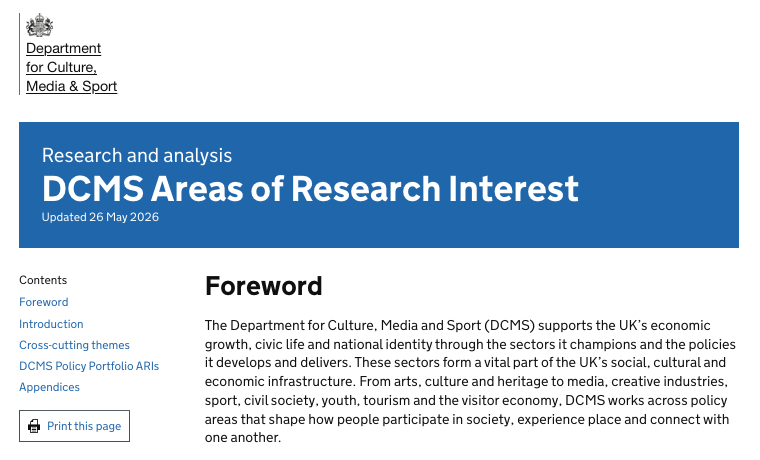
The refreshed DCMS Areas of Research Interest, published on GOV.UK in May 2026.
Areas of Research Interest, or ARIs, are an important part of how government departments communicate their evidence needs to the wider research, innovation, analytical and policy communities. They set out the questions where new knowledge, data, analysis and methodological development can help inform better policy. For DCMS, this matters because the department’s portfolio is unusually broad, spanning the creative industries, culture, heritage, media, sport, civil society, youth, tourism, gambling and international engagement.
This is the third set of DCMS ARIs, following earlier publications in 2018 and 2023. That continuity and progression is important; ARIs should not be one-off documents. At their best, they are part of an ongoing conversation between government and the wider evidence ecosystem: universities, research institutes, national academies, industry, arm’s length bodies, civil society organisations, practitioners, funders and communities themselves.
As DCMS Chief Scientific Adviser, I have had overall responsibility for this refresh as part of my wider priority to strengthen DCMS’s science, research and evidence system. The real work of developing the ARIs, however, has been a strongly collaborative effort across the department. I am especially grateful to the excellent DCMS CSA team who have undertaken the detailed engagement across policy and analytical teams, refined the questions, and brought a complex departmental evidence landscape together into a coherent final document. I am also grateful to Professor Elizabeth Lomas (UCL), DCMS ARI Policy Fellow, and Professor Dave O’Brien (University of Manchester), DCMS UKRI Policy Fellow, whose embedded expertise, input and challenge have helped shape this important new iteration of the ARIs. The refresh has also benefited from valuable test and challenge from members of the DCMS College of Experts.
The 2026 refresh comes at a significant moment for the department and for the sectors it supports. DCMS sectors are central to growth, jobs, innovation, international influence and the UK’s soft power. They are also fundamental to quality of life, civic participation, social cohesion, identity, trust and place. Cultural institutions, heritage assets, sports facilities, community organisations, youth services, local media, creative clusters and visitor destinations are not simply sectoral assets. They form part of the social, cultural and economic infrastructure through which people experience opportunity, belonging and participation. That wider framing has shaped the new ARIs.
One of the most important features of the refresh is the stronger emphasis on cross-cutting themes. The document is still organised around DCMS policy portfolios, because policy questions need ownership and specificity. But many of the most significant evidence challenges do not sit neatly within a single portfolio boundary. The refreshed ARIs therefore identify a set of cross-cutting themes that run across the department’s work: growth; place, pride and social cohesion; participation and engagement; prevention and early intervention; value, valuation and valorisation; major events and national moments; artificial intelligence and digital technologies; resilience; environmental sustainability; and what works and evaluation.
These themes are not decorative. They are intended to help researchers, analysts, funders and policy teams see the connections across DCMS sectors. They also reflect the fact that many of the department’s most important questions are questions about complex and dynamic systems: how economic, cultural, technological and civic systems interact; how social, cultural and information infrastructure supports places, communities and public trust; how interventions generate benefits over time; how risks propagate through sectors and supply chains; and how public value is created, distributed and sustained.
This matters because the most important public policy questions facing DCMS sectors are increasingly systemic. How do cultural and creative assets contribute to growth, productivity, innovation and soft power? How do they also support local identity, pride in place and social cohesion? How can participation in sport, culture, youth services, volunteering or heritage support prevention and reduce long-term demand on public services? How should we understand, measure and apply the value of cultural, social and civic infrastructure in policy and investment decisions? How do AI and digital technologies affect trust, production, distribution, creativity, labour markets, public participation and the integrity of the information ecosystem? How do DCMS sectors contribute to resilience in a more uncertain geopolitical, technological and social environment, including through a whole-of-society approach to shocks and disruption?
These are not questions that can be answered adequately from any single discipline or method. They require social sciences, economics, arts and humanities research, data science, engineering, design, behavioural science, evaluation, futures methods, meaningful public engagement and lived experience. They also require the habits of systems thinking: understanding interdependencies, incentives, feedback loops, implementation constraints, assurance, resilience and unintended consequences. For me, this is central to the role of a departmental Chief Scientific Adviser: helping the department ask better questions, connect different forms of expertise, and build the evidence infrastructure needed for more robust, adaptive and accountable policymaking.
This is also why the refreshed ARIs place considerable emphasis on DCMS as a mature and sophisticated commissioner and user of research. That phrase is not simply about commissioning more studies. It is about asking sharper questions, understanding what kind of evidence is needed for different policy problems, using methodological pluralism well, and being clear about how research can inform decision-making.
The Culture and Heritage Capital programme is a good example of this wider direction of travel. As Senior Responsible Owner (SRO) for the programme, I see it as one of the clearest examples of DCMS building the analytical infrastructure needed to understand the full value of its sectors. It sits directly alongside the ARIs’ cross-cutting theme of value, valuation and valorisation: not only how value is understood and measured, but how it is applied in decision-making, appraisal, investment and policy design. This is not just a technical exercise in valuation. It is part of a broader shift towards recognising the multiple forms of value created by DCMS sectors, including economic, social, cultural and environmental benefits, and the wider spillovers they generate across communities, places and the economy.
The same logic applies across the ARIs, where questions of public value, distribution, access, participation and long-term impact recur throughout the document. So too do questions about data quality, evaluation, causality, transferability and implementation. For government, the challenge is not simply to know whether something is valuable in general terms. It is to understand what works, for whom, in which places, through what mechanisms, at what cost, and with what wider effects.
The refreshed ARIs also reflect the changing technological context for DCMS. Artificial intelligence and digital technologies are now central not only to almost every part of the department’s portfolio, but to the wider social, cultural and economic systems in which DCMS sectors operate. They are reshaping creative production, media consumption, audience behaviour, gambling products, sport analytics, cultural engagement, heritage interpretation, tourism, public trust and the wider information environment. The ARIs therefore ask not only about technology adoption, but about responsible development, deployment and use: governance, accountability, inclusion, resilience, intellectual property, skills, provenance, media literacy, public trust and the integrity of the information ecosystem. More broadly, they ask how digital technologies shape the conditions for a good digital society.
That breadth is deliberate. DCMS has a distinctive role in government because many of its sectors sit at the intersection of economic growth, cultural life, technological change and civic trust. The evidence base we need must be capable of engaging with that complexity. The publication of the ARIs is therefore not the end of a process. It is the beginning of the next stage of engagement. Documents like this only matter if they are used: by researchers shaping programmes of work; by funders identifying areas of strategic need; by policy teams asking better questions; by analysts testing assumptions; by sector bodies and practitioners bringing evidence from delivery; and by communities helping government understand how policy is experienced in practice. That is the real test of this refresh: not whether the ARIs have been signed off and published, but whether they help structure better conversations, support better research, sharpen the evidence base, and improve the connection between research and policy across DCMS sectors.
We want researchers and partners to use the document as a route into conversation with DCMS: to identify where existing evidence can help, where new research is needed, where methods need to be developed, and where collaboration across disciplines and sectors can strengthen policy. This includes established researchers and institutions, but also early-career researchers, community researchers, practitioners, industry specialists, analysts, sector bodies and organisations with applied evidence from delivery. Some of the most useful insights for government come from those working close to implementation, where the practical realities of policy, place and public value are most visible.
Good evidence does not remove the difficulty of policymaking; nor should it pretend to. It can, however, improve the quality of the questions we ask, the options we consider, the trade-offs we understand, and the decisions we take. In that sense, evidence is not simply an input to policy. It is part of the national capability we need for more adaptive, accountable and effective government. That is the spirit in which these refreshed ARIs have been developed. They are an invitation to help build the interdisciplinary evidence infrastructure needed for the next phase of DCMS policy: supporting growth, strengthening communities, improving outcomes, and understanding the full public value of the sectors that shape so much of our national life.
The refreshed DCMS ARIs are available on GOV.UK; they will also be discoverable through the ARI database, which allows researchers to search, browse and analyse ARIs across UK governmental bodies and identify connections between departmental evidence needs.
I hope researchers, practitioners and partners across the UK and internationally will read them, engage with them, and work with us to strengthen the evidence base for culture, media, sport and civil society. The challenge now is to make them useful and usable: to turn a published document into better conversations, stronger collaborations, sharper research questions, and evidence that can support better decisions in the real world.


2 thoughts