On being appointed an RSS William Guy Lecturer for 2026/27.
I am pleased to share that I have been appointed as one of the Royal Statistical Society’s William Guy Lecturers for 2026/27, delivering the 16+ lecture: Can You Trust the Numbers? Statistics, Misinformation and the Information Ecosystem.
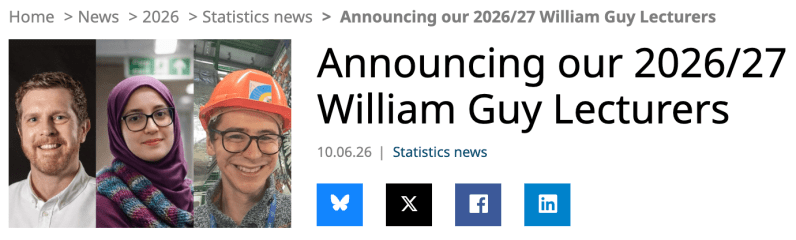
The Royal Statistical Society’s 2026/27 William Guy Lecturers. Image: RSS.
The William Guy Lectureship is a long-running public engagement programme of the RSS, designed to introduce school and college students to the value of statistics and statistical thinking. Named after Dr William Guy, one of the Society’s founders, the lectures have been delivered by leading statisticians, researchers and communicators for many years. This year’s cohort of three lecturers share a common thread: all three talks engage, in different ways, with the challenge of navigating misinformation and understanding data in an information environment where claims travel quickly, context is often lost, and confidence can be mistaken for accuracy.
The title of my own lecture reflects questions that have increasingly sat across much of my work in recent years. My background is in computer science and digital technologies, but much of my work now sits at the intersection of technology, public policy and society. Many of the challenges that preoccupy researchers, policymakers and public institutions are ultimately questions about evidence, trust and decision-making: how do we assess competing claims, deal with uncertainty, and make sense of complex social, technological and economic systems? Statistics sits at the heart of all of those questions.
We are surrounded by data, metrics, dashboards, rankings, surveys and forecasts. Statistical evidence shapes decisions about healthcare, education, public services, the economy and the environment. Yet we also live in an information ecosystem where misinformation spreads rapidly, where the same data can be presented to illuminate or to mislead, and where the appearance of precision can be mistaken for the reality of it. This makes statistical literacy important — not simply as a technical skill, but as part of how we engage with public debate, public policy and democratic life.
The lecture will draw on examples from policy, media and everyday life to think about how evidence can inform better decisions, how numbers can be misunderstood or misrepresented, and what questions anyone can ask when they encounter a statistic, a graph or a headline. It will also connect to a question I find myself returning to repeatedly across my work at both DCMS and Bristol: what does a good digital society look like? The quality of our information ecosystem is not simply a technical matter. It is a social, civic and educational one too — shaping how people understand evidence and participate in public life long before they reach the workplace or the ballot box.
I am looking forward to engaging with students across the UK through the programme over the coming year. The lectures will be available for schools to book from 1 August 2026, and recordings will be made available on the RSS website and YouTube channel from the start of the academic year. I will share more on dates and venues as they are confirmed.


2 thoughts