My introduction to Star Trek was through repeats of The Original Series, watched in the early evening after school. By the time I encountered The Next Generation at secondary school, I was already familiar with the Enterprise, its crew and the possibilities of the universe they inhabited. I followed the series, the films and much of the wider Star Trek universe over the decades that followed, but Jean-Luc Picard became my favourite captain, and Patrick Stewart one of my favourite actors. He died on 28 October 2026, aged 86.
What appealed to me initially was Picard’s intelligence, authority and strong sense of right and wrong, alongside the excitement of exploration and discovery that The Next Generation offered. Stewart made him someone I looked up to, particularly through his encounters with Q and the Borg, which challenged his authority and exposed his vulnerabilities. I doubt I fully appreciated at the time how much his curiosity, respect for expertise and willingness to reconsider his judgement would come to influence my own thinking.
I have been fortunate throughout my career to work with some excellent leaders, including chairs of boards on which I have served. I have particularly admired those who make room for disagreement, take evidence seriously and accept responsibility for difficult decisions. I suspect Picard helped shape some of those expectations long before I had the experience to recognise them in others.
Stewart made these qualities believable through his performances. His voice, timing and command of language could give a speech considerable force, but he was equally effective in quieter moments of uncertainty, disappointment or regret. Across seven seasons of television, four films and his later return to Picard, he gave the character a depth and consistency that made his changing experiences and judgements matter. I still return to particular episodes and speeches, both for the ideas they explore and for what Stewart brought to them as an actor.
Truth, evidence and judgement
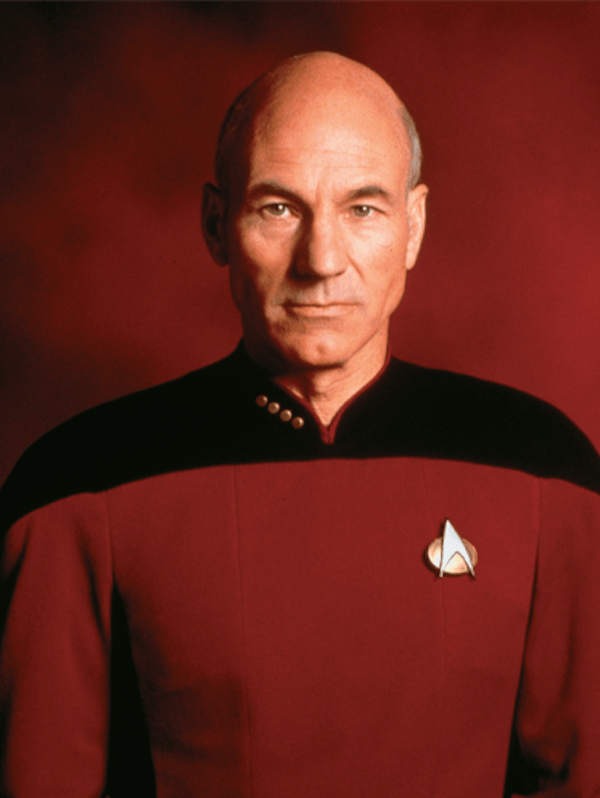
In “The First Duty”, Picard confronts Wesley Crusher following a fatal accident and an attempted cover-up. His declaration that “The first duty of every Starfleet officer is to the truth” extends explicitly to scientific, historical and personal truth, making it one of the clearest statements of professional integrity in the series. Picard is confronting someone he cares about, knowing that telling the truth may have serious personal and professional consequences. Stewart conveys both his disappointment in Wesley and his determination that personal loyalty cannot override professional responsibility. The speech carries weight because the principles are being tested in circumstances where applying them will be difficult and potentially painful.
Much of my professional life has involved bringing research and evidence into settings where decisions must be made despite complexity, uncertainty, competing priorities and limited resources. Evidence has to be gathered, scrutinised and interpreted, with its limitations made clear. That requires distinguishing what the evidence supports from the judgements and choices that follow, and being prepared to challenge assumptions, including our own. Sometimes that means saying that the evidence does not support a specific conclusion, even when doing so is difficult or unwelcome.
Picard was also the captain of a remarkable scientific and technical community; he was not the expert in everything, nor did he pretend to be. He drew upon the knowledge and experience of his crew, encouraged discussion and challenge, and ultimately had to exercise judgement and accept responsibility for the decisions made. I recognise much of that in the demands of leadership within complex organisations, where authority should never be confused with having all the answers.
Another favourite moment comes in “Peak Performance”, when Data struggles to understand how he could have lost a strategic contest despite making no mistakes. Picard explains that it is possible to do everything correctly and still lose. Stewart delivers this with a gentleness quite different from the commanding speeches for which he is often remembered, helping Data understand something fundamental about uncertainty and the nature of experience.
Outcomes matter, of course, but they are not always reliable measures of the quality of a decision; chance, incomplete information and circumstances beyond our control all play their part. Good judgement does not guarantee success, just as a successful outcome does not necessarily vindicate the reasoning that produced it.
Rights and the exercise of power
In “The Measure of a Man”, Picard defends Data against an attempt to classify him as Starfleet property and dismantle him for research. The immediate question concerns one android, but the argument reaches much further into who gets to determine whose interests matter, what constitutes sufficient evidence, and whether technological capability provides moral justification for its use. I would resist treating the episode as a prediction of modern AI; however, its questions about capability, authority and responsibility also run through my recent writing about AI, automation and the limits of delegation.
“The Drumhead” is similarly powerful. An investigation into suspected sabotage becomes an increasingly indiscriminate pursuit of supposed enemies, with suspicion and institutional self-protection gradually displacing evidence and due process. Picard invokes the warning of Judge Aaron Satie, whose daughter is leading the investigation: “With the first link, the chain is forged.” It is a warning about the gradual erosion of freedom, and how readily apparently defensible restrictions can become part of something much more dangerous.
Stewart’s restraint is effective here. Picard understands the seriousness of the threat, but also the dangers of abandoning due process and proportionality in the name of protecting an institution. The performance moves from controlled questioning to a forceful defence of principle, with the authority coming through the seriousness of the argument and the precision of its delivery.
Humanity on trial
Some of my favourite exchanges were between Picard and Q, brilliantly played by John de Lancie. Their relationship was often funny, antagonistic and occasionally absurd, but it also provided some of the most interesting philosophical arguments in Star Trek. Stewart and de Lancie played wonderfully against one another, with a combination of intellectual confrontation and theatrical mischief that gave their scenes a distinctive quality.
From the opening episode of The Next Generation, Q places humanity on trial, challenging Picard to defend a species with a long history of violence, intolerance and self-destruction. Picard resists Q’s contempt for humanity, while Q repeatedly exposes the distance between its aspirations and its actual behaviour. Their encounters became increasingly concerned with what humanity might become, and whether it could learn to move beyond its existing limitations.
When I shared a video of some of Picard’s speeches back in 2019, it opened with an exchange from “Hide and Q”. Q draws upon Shakespeare, invoking As You Like It and then Macbeth’s bleak account of life as a walking shadow, full of sound and fury, signifying nothing. Picard responds with Hamlet’s celebrated reflection: “What a piece of work is man! How noble in reason”, drawing upon Shakespeare to make an argument about the potential of humanity. Hamlet speaks those words with irony and disillusionment, while Picard delivers them with conviction. It is characteristic of The Next Generation that a disagreement between an omnipotent being and a starship captain could become a serious argument about human nature, conducted through Shakespeare in the middle of a science fiction television programme.
In “True Q”, when Q threatens Amanda Rogers, a young woman raised as a human who discovers she possesses the powers of the Q Continuum, Picard challenges the moral pretensions of these supposedly superior beings. He questions their claim to act as the moral guardians of the universe, arguing that their near-omnipotence does not establish any superior moral authority. Humanity’s imperfect behaviour might reveal something that the Q themselves lack: a moral centre. The cruel irony, Picard argues, would be for the Q to destroy Amanda precisely because she is too human.
Q responds with characteristic amusement: “Jean-Luc, sometimes I think the only reason I come here is to listen to these wonderful speeches of yours.” It punctures Picard’s solemnity without diminishing the argument, and the exchange works because of Stewart’s delivery and de Lancie’s obvious enjoyment of the moment. There was considerable affection in the way their characters sparred, even when the stakes were substantial, and the humour provided a welcome counterpoint to Picard’s moral seriousness.
“Tapestry” offers a more personal examination of Picard’s character. Q gives him an opportunity to revisit decisions from his youth that he has long regretted, particularly the reckless confrontation that led to his being stabbed through the heart. Changing that experience also alters the course of his life, removing some of the risks and mistakes through which his later identity and ambitions developed. Picard rejects the safer, less consequential life that results, unable to recognise himself in the person he has become. I recognise the temptation to revisit earlier choices, although the things we regret are also part of the experience through which we learn. That does not make every mistake necessary or harmless.
In the series finale, “All Good Things…”, Q reminds Picard that the trial never ends. By then, their relationship has evolved considerably. Q is still testing him, but also pushing him to think beyond the boundaries of his existing understanding and recognise possibilities he had previously been unable to see. I like that idea. However much experience we accumulate, we can still get things wrong, and it is worth having people around us who will tell us so.
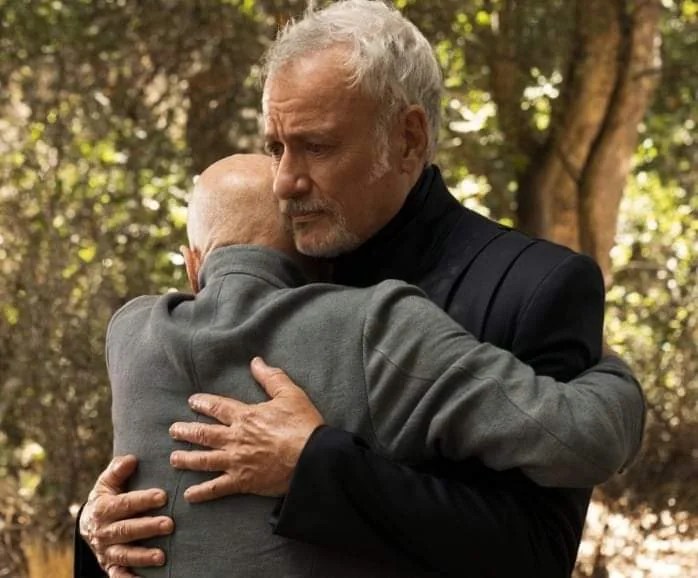
Their relationship continued into Star Trek: Picard, including an unexpectedly moving farewell in the second season episode “Farewell”, when the two characters finally embrace. After decades of antagonism, argument and Q’s repeated attempts to test Picard, there is a moment of genuine affection between them. Following Stewart’s death, John de Lancie recalled the pleasure of having been a thorn in Picard’s side for nearly forty years, praising Stewart’s intelligence and depth as an actor, and describing the privilege of working alongside him. He ended his tribute with the words: “See you out there, Mon Capitaine.” Coming from the actor whose character had spent so long challenging Picard’s understanding of humanity, it was a fitting and personal farewell.
The Borg and the limits of conviction
If Q repeatedly challenged Picard’s confidence in humanity, the Borg confronted him with something far more personal. First encountered by the Enterprise in “Q Who”, when Q transports the ship into unexplored space, they represented an overwhelming technological power that threatened individuality, autonomy and everything Picard valued about human freedom. Their assimilation of Picard in “The Best of Both Worlds” remains one of the defining moments of The Next Generation, transforming the captain we had come to know into Locutus, an instrument of the very power he had sought to resist.
Picard’s authority and self-possession disappeared behind the impersonal certainty of the Collective, and his eventual rescue did not simply restore the person he had been. “Family”, in which he returns home and confronts his brother Robert, is especially important in showing the vulnerability and psychological consequences that remained. His emotional collapse during their confrontation is one of Stewart’s finest performances in the series, exposing the trauma beneath Picard’s familiar composure and professional authority.
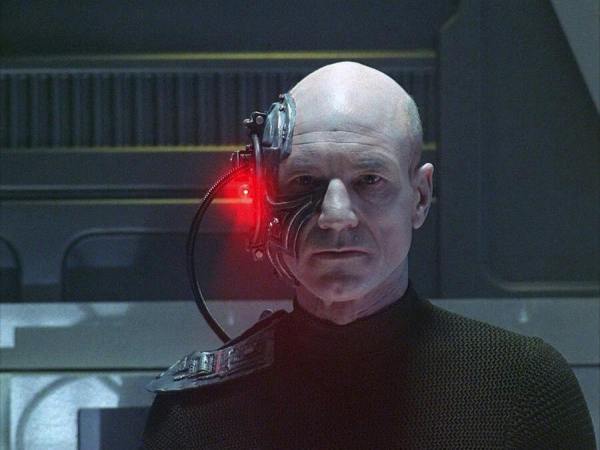
Those experiences return in “I, Borg”, when the Enterprise rescues an injured Borg drone who comes to be known as Hugh. Picard initially sees an opportunity to use him to destroy the Collective, but Beverly Crusher’s objections and Hugh’s developing relationship with Geordi La Forge lead him to reconsider. He has to recognise an individual where he had previously seen only the Collective.
In Star Trek: First Contact, Picard’s unresolved experiences come to the surface again. His furious insistence that the line must be drawn against the Borg is one of Stewart’s most memorable performances, delivered with such conviction that it is easy to overlook how badly his desire for revenge has compromised his judgement. It takes Lily Sloan, someone outside Starfleet and its command structures, to confront him with what he refuses to acknowledge. He initially rejects her challenge before finally recognising that she is right.
The difficult part is that Picard has the authority to prevail, even when he is wrong. Lily’s challenge matters because he eventually allows it to change his decision. I’ve had to reconsider decisions when someone else has seen something I missed.
Science and culture, from Shakespeare to the stars
For all its technological ambition, The Next Generation imagined a future in which scientific progress and human progress were closely connected, although the relationship between them was never straightforward. Its broadly optimistic, sometimes near-utopian vision of humanity assumed extraordinary scientific and technological capability, yet its most interesting stories were often about moral uncertainty, institutional failure, prejudice and the limits of our understanding.
Developments in science and engineering made exploration possible, but deciding how to respond to what the crew encountered demanded a much wider range of knowledge and judgement, drawing on history, literature, philosophy, law, diplomacy and science itself. Picard was fascinated by archaeology, deeply interested in other cultures and entirely comfortable drawing upon Shakespeare to make an argument about humanity’s future. His intellectual and cultural interests informed how he understood responsibility, negotiated conflict and exercised judgement, and were as much a part of his character as his command of a technologically advanced starship.
One of my favourite illustrations of this comes in “Darmok”, when Picard struggles to communicate with Dathon, the alien captain played by Paul Winfield, whose language relies upon references to stories and mythology unfamiliar to the Enterprise crew. The universal translator can render the words, but their meaning remains inaccessible without an understanding of the cultural references behind them. Stranded together, Picard and Dathon gradually begin to understand one another through shared experience and storytelling, including Picard’s account of Gilgamesh and Enkidu. Picard eventually realises that Dathon has placed them both in danger to establish a way of communicating. Even the phrase “Shaka, when the walls fell”, expressing failure, has become part of Star Trek’s wider cultural vocabulary.
I have thought about this in relation to C. P. Snow’s famous argument about the two cultures. Snow was concerned about the separation of scientific and literary intellectual life, and the consequences of that division for society. Star Trek offered an imagined future in which scientific understanding and cultural knowledge were both essential to human flourishing. Greater technological capability did not make questions about rights, morality, meaning or responsibility any less important, nor did it remove the need to understand the people and societies affected by scientific progress.
Stewart was well suited to bringing that vision to life. A proud Yorkshireman, born and raised in Mirfield, he discovered Shakespeare through his English teacher, Cecil Dormand, at secondary modern school. Stewart repeatedly credited Dormand with changing his life, introducing him to the experience of performing Shakespeare and encouraging his interest in theatre. He eventually joined the Royal Shakespeare Company in 1966, appearing in more than forty productions across a remarkable range of roles, from early ensemble parts to Shylock, Macbeth, Prospero, Leontes and Claudius. His stage career gave him experience of characters marked by ambition, jealousy, uncertainty, regret and considerable emotional complexity.
Stewart’s route to Picard was unexpected. While teaching Shakespeare masterclasses in Los Angeles at the invitation of an academic friend, he gave a public lecture and performance attended by Star Trek producer Robert Justman. Stewart recalled the experience in a 1988 interview with Terry Wogan, when he was still coming to terms with the programme’s following and the unexpected direction his career had taken.
There is a rather lovely detail connecting Stewart’s theatrical career with Picard’s fictional world. Jörg Hillebrand’s painstaking research into the Shakespeare books displayed in Picard’s ready room revealed that one edition of The Annotated Shakespeare contains a photograph of Stewart himself, performing as Touchstone in the Royal Shakespeare Company’s 1968 production of As You Like It. The relevant pages appear on screen in four episodes, including “True Q”. The discovery is illustrated in a fascinating 2025 article and interview with Hillebrand, raising the amusing possibility that Patrick Stewart himself exists within the Star Trek universe.
His classical training was evident in his approach to Picard, from the precision of his language to his control of pace and silence. He understood the emotional and intellectual substance of a scene, and could make an argument about moral philosophy compelling television without reducing it to a lecture. The anger, vulnerability, humour and hesitation were just as important as the speeches, giving the character considerably more depth than his professional authority alone could have provided.
Stewart was also candid about how much he had learned from the people around him. In the early days of The Next Generation, he found the more relaxed atmosphere on set difficult after years of working in classical theatre, and became frustrated with colleagues joking between takes. He famously reprimanded the cast, insisting that they were not there to have fun, an incident he later recalled with considerable embarrassment and humour. His colleagues helped him discover a different way of working, and he came to recognise that professionalism and enjoyment were entirely compatible.
When Stewart returned to the character in Star Trek: Picard, he was interested in exploring how age, experience and changing relationships had altered Picard, something he also discussed in his 2023 memoir, Making It So. His performance was more emotionally open, reflecting a character whose responsibilities and circumstances were very different from those of the captain we first encountered on the bridge of the Enterprise.
A Shakespearean actor became the central figure in one of popular culture’s most enduring visions of a scientific future, bringing questions about knowledge, progress, human values and our responsibilities to one another to audiences far beyond academia. I have always valued that connection between science and culture, particularly the ways in which fiction, performance and storytelling can influence what we imagine to be possible and how we think about the futures we might want to help shape.
Yorkshire, friendship and public life
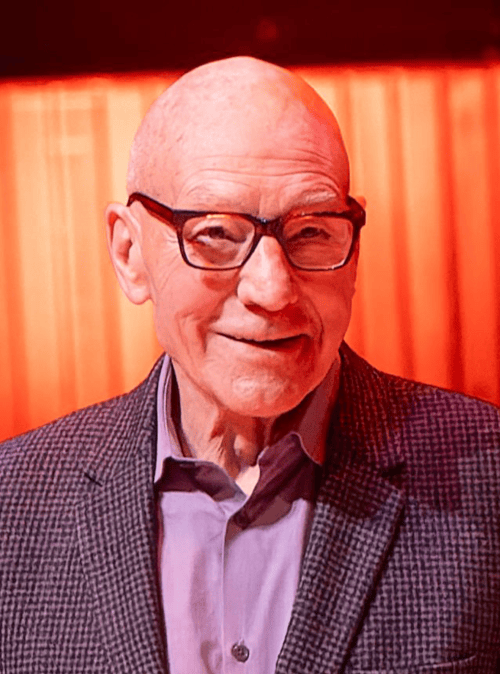
Stewart remained closely connected to his Yorkshire roots throughout his life, including through his long association with the University of Huddersfield, where he served as Chancellor from 2004 to 2015. His commitment to education and the opportunities it could create for young people was an important part of his public life.
His friend Sir Ian McKellen described the Huddersfield chancellorship as Stewart’s proudest achievement. Their friendship extended across their theatrical careers, their work together in X-Men and their later stage collaborations. In his tribute, McKellen also recalled warning Stewart that accepting a leading role in Star Trek might jeopardise his established career in British theatre, an interesting recollection given everything that followed. He wrote movingly about Stewart’s Yorkshire identity, honesty and emotional openness: “He wore his heart on his sleeve, which made him a man to rely on, to admire and in my case, love.”
Brian Blessed’s tribute reaches back even further, to when the two met as young lads on a drama course in the Calder Valley. Blessed remembered Stewart’s reserved manner, the warmth of his smile and their shared enthusiasm for acting, describing the beginning of their journey as “through Shakespeare to the stars”. He recalled a friendship that never diminished, with Stewart greeting him with the same affection they had shared as boys, and never being afraid to show his emotions. His account offers a glimpse of the young Yorkshire actor before the international recognition, and of a friendship that endured through two remarkable careers.
Stewart also used his public profile to support causes that mattered deeply to him, particularly his long association with Refuge. Drawing upon his own childhood experiences of domestic abuse, he spoke openly about its consequences and helped bring greater attention to the experiences of women and children. His willingness to use his public voice in this way, alongside his support for education and human rights, deserves recognition as an important part of his life beyond the stage and screen.
What remains
Stewart has an unusually quiet moment in “Where Silence Has Lease”, when Picard faces the possible destruction of the Enterprise and is asked what death means by someone who appears to be Data, but is actually an alien entity attempting to understand and manipulate him. Picard considers different religious and philosophical accounts of mortality, reflecting on the complexity of the universe and the possibility that existence extends beyond our present understanding.
In “The Inner Light”, Picard experiences an entire lifetime on another world, building a family and a life far removed from the Enterprise. His encouragement to his daughter to seize the time and live in the present resonates differently now. The episode also explores memory and what survives us: Picard becomes the bearer of the experiences of a civilisation that has disappeared, preserving something of its culture and history through the life he has lived. A related reflection comes near the end of Star Trek Generations, when Picard describes time as a companion accompanying us through life, rather than something to be feared or resisted.
Stewart’s career extended far beyond Star Trek, encompassing decades of Shakespearean theatre, Professor Charles Xavier in the X-Men films, his portrayal of Gurney Halleck in David Lynch’s Dune and his wider public advocacy. There have already been many thoughtful obituaries and tributes covering the breadth of his life and career. But it is Picard I have found myself returning to most often, perhaps because I first encountered him at an age when I was beginning to develop my own interests, values and understanding of the world.
In a 2023 NPR interview, Stewart was asked whether playing Jean-Luc Picard had made him a better person. His answer was striking: “It gave me an idea of how I might become a better person, yes.” He explained that he had tried to incorporate some of Picard’s qualities into his own life, and spoke with pride about people who had told him how The Next Generation had helped them through difficult periods. The work had acquired a significance far beyond the performances themselves, and Stewart was conscious of that responsibility.
I had not previously appreciated quite how directly Stewart had spoken about learning from Picard himself. For an actor who portrayed such a commanding and authoritative figure, his answer was notably modest. Playing the character gave him something to aspire to, just as watching that portrayal helped establish some of the expectations I have subsequently brought to my own understanding of leadership.
As a teenager, I was drawn to Picard’s confidence, his sense of right and wrong, and the possibilities of exploration. I now find myself returning more often to the moments when he is uncertain or wrong, and to the people prepared to challenge him. I’ve learned from leaders who have shown that same openness, and I have made decisions of my own that I would approach differently today. I hope I have become better at recognising the limits of my knowledge, accepting challenge and changing my mind when the evidence warrants it. Experience alone, however, guarantees none of those things, and greater responsibility can sometimes make it harder to recognise when our assumptions are mistaken.
I still have plenty to learn, and no doubt plenty of mistakes to make. Stewart’s ability to make Picard’s convictions persuasive, his mistakes uncomfortable and his moments of vulnerability genuinely human is one reason those performances have stayed with me for so long. I will miss him.


