I was very sad to hear that Professor John Fitch, my undergraduate dissertation and PhD supervisor at the University of Bath, passed away in June 2026. This is a personal reflection on someone who had a significant influence on my own path into academic life — not a formal obituary, or any kind of definitive account of his life and career; others are far better placed to write that.
John — also known to generations of students and colleagues as John ffitch — was a distinctive computer scientist, mathematician, software engineer and composer, with a rare breadth of work across computer algebra, Lisp, compilers, and computer music. In the 1980s he was a director of Codemist, which built the C compiler for the then-new ARM processor and went on to port it across a range of other systems — a very concrete, unglamorous kind of impact that quietly underpins an enormous amount of computing since. Later he became project leader for Csound, and his work there and in computer music led him into composition, and to an adjunct professorship at Maynooth University. He didn’t fit neatly into a single academic box or sub-discipline, and he was all the better for it. Talk to different people who knew him and you’ll get different doorways into who he was: some knew him through Unix, BCPL and C; others through computer algebra, compilers, Csound and computer music. The range itself says something important about the kind of scholar, and person, he was.
He had joined Bath as Professor of Software Engineering and Head of the Computing Group in 1980 (the year before I was born), after many years at Cambridge. By the time I encountered him as an undergraduate at the turn of the millennium, he already carried with him a deep well of experience and stories from an earlier generation of computing — punch cards, oscilloscopes, the debugging of some of Cambridge’s early machines — that made a strong impression on a student who had grown up with none of that history in view.
My first substantive encounter with John began with my undergraduate dissertation in 2003. He gave me room to explore my own direction, while being equally clear that good work required precision, patience and intellectual seriousness. That combination of freedom and rigour, I think, is what made doctoral study feel like a realistic and appealing next step rather than a distant abstraction. Without that undergraduate supervision, I doubt I would have found my way to a PhD, let alone an academic career.
He went on to supervise that PhD: Superoptimisation: Provably Optimal Code Generation using Answer Set Programming, alongside Dr Marina De Vos, then a recently-appointed lecturer from Belgium. The pairing worked well — John’s decades of experience against Marina’s early-career energy and fresh perspective — and the technical subject matter sat at the intersection of compilers, logic programming and real-world combinatorial optimisation, but the more valuable lessons went beyond the thesis itself: how to frame a research question properly, how to build and defend a technical argument, and how to stay with a hard problem for as long as it took to solve. Those are skills I still rely on, long after the technical detail of the thesis itself has faded.
John could be wonderfully quirky, but never in a way that displaced the seriousness of the work underneath. He was, by his own account on his old Bath webpage, never a hippie — despite the long hair, the beard, and the persistently uncertain spelling of his name. He also liked to note that he’d held the Chair of Software Engineering at Bath for most of his career, a subject, as he put it himself, “about which he knew little“. He was precise, theoretically grounded and deeply experienced, with a dry wit that never got in the way of that precision; if anything, it sharpened it. A conversation with him could begin with a technical detail of code generation and end up somewhere in music, mathematics, university politics, or the general oddities of academic life, and each detour felt like part of the point, not an interruption to it. We used to talk about sport, too: mine was karate and rugby as a student, his, it turned out, had been rowing and, his real passion, tiddlywinks, which I have no trouble believing he played with exactly the same precision he brought to spotting a missing bracket in code.
Some of my clearest memories of that period aren’t of formal supervision meetings at all, but of afternoon coffees in the Claverton Rooms, at the time the senior common room on the Bath campus, with department colleagues and other PhD students. Those conversations ranged widely and unpredictably, from arcane bits of mathematics and programming language semantics to university governance and British politics, and they were part of my education too, a glimpse of academic life as a wider intellectual practice, not simply the production of papers or the completion of a thesis on schedule.
After I posted a short note on LinkedIn marking his passing, a number of former students and colleagues got in touch with their own memories of John, and reading through them was a reminder that none of this was mine alone. People remembered his generosity with undergraduates and with new colleagues arriving at Bath, and his willingness to stop and talk through a technical problem with whoever happened to drop by the department. Others recalled his stories of early computing, computer music and Cambridge, alongside a rigour about the work that always sat next to real kindness. One former student captured it as neatly as anyone: a ferocious appetite for code and engineering, matched with a gentleness towards the people doing it. Others remembered him still coming into the department for years after his formal retirement, full of life, part of the ongoing atmosphere of Bath Computer Science rather than a figure from its past.
I left Bath in 2009 to begin my own academic career in Wales, and I hadn’t seen John for some years after that, though we stayed in occasional, infrequent contact — directly, and indirectly through Professor James Davenport, another of his former students and a long-time collaborator of mine, including through the BCS. I rather regret not making more effort to stay in touch with John myself over recent years; James was the one who let me know he had died. But academic influence isn’t measured only by how often you were in touch. Some people shape the way you think early on, and that shaping doesn’t fade just because the formal supervisory relationship has long since ended.
I’m grateful for his supervision, for his generosity with his time, and for the model of academic life he offered: rigorous and independent, but never narrow, and always intellectually alive. My thoughts are with his wife Audrey, and with his family, friends, colleagues and former students.
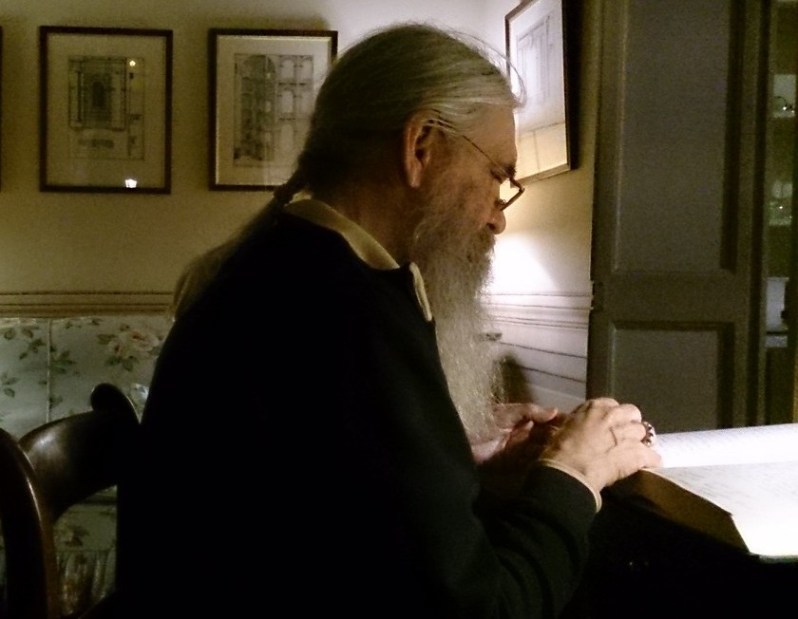
(photo of John in the Keats-Shelley House in Rome c.2013, with kind permission of Audrey Fitch)


One thought