On 11 April 2011, I published a short post entitled “Hello, World!”. Fifteen years, three domain names and two changes of title later, this post brings the total to five hundred.
I didn’t begin with a plan to write five hundred posts. To be honest, I’m not sure I had much of a plan at all.
The blog began at drtomcrick.wordpress.com, before moving to drtomcrick.com and eventually to proftomcrick.com. The domain names alone tell part of the story, although perhaps not a particularly subtle part. My apologies to any other academic-adjacent Tom Cricks: I appear to have acquired the majority of the obvious domain names over the years.
Its title has changed too: from Computing: The Science of Nearly Everything, through Digital, Data & Policy, to its current incarnation as Digital Society & Policy, with the subtitle Technology, systems and public policy. As I wrote earlier this year, these changes have reflected a widening field of view rather than a sequence of clean breaks. The technologies have evolved, my professional roles have changed, and the language I use to frame those questions has shifted. Many of the underlying concerns have been remarkably persistent.
Indeed, the first substantive post appeared the following day: “Computing: Enabling a Digital Wales?”. Computing, education, Wales and public policy were connected from the outset. Later posts on computational thinking and problem-solving, what it means to be a computer scientist, and the ICT Steering Group’s 2013 report to the Welsh Government now form part of a much longer record of curriculum and qualifications reform in Wales.
Across five hundred posts, the recurring subjects have been computing as a discipline and as a school subject; universities, research and academic life; Wales, devolution and public policy; data, AI and digital transformation; the institutions through which evidence reaches government; and the people and professional communities I have worked in.
There have also been books I intended to read, tried to read and occasionally actually read; quotations I wanted to keep somewhere; bits of mathematics, computing, language and culture that interested or amused me; recurring appearances by Douglas Adams, The Hitchhiker’s Guide to the Galaxy and Richard Feynman; and a substantial miscellany of things that seemed funny, odd or worth remembering at the time.
This includes posts on the most remarkable formula in all of mathematics, the day there was no news, a real-life Unix pipe, email etiquette, legal disjunction and inspirational speeches of Star Trek. Some involved a developed argument; others, such as the Unix pipe and the Star Trek posts, were little more than a photograph or a video. There was room for both.
One of the pleasures of looking back through the archive is seeing how early some of these preoccupations appeared. “Eddies in the space-time continuum” appeared in June 2011. The relationship between science, evidence and public argument was there in posts on Fukushima, a “chemical-free” world, logical fallacies and policy, science and the public. Questions of infrastructure appeared too, from the undersea cables wiring the Earth in 2014 to data as infrastructure in 2018. The latter linked data governance to physical infrastructure, public services and the public good: an argument that now sits near the centre of much of my wider systems thinking.
Public engagement with computer science also featured, from visualising Diffie–Hellman key exchange to a short reminder that computer vision is still hard. Posts on Superman III, tsundoku and the perils of chess sat quite naturally alongside research, curriculum reform and higher education policy. I did not consciously plan or curate that mixture; it is simply what the blog became.
Thinking in public
Although a blog is public, much of the writing has been for me: a way of working out what I think, trying different forms of writing and giving an idea enough shape to see whether it stands up.
Academic writing is a particular kind of work, with its own disciplines, conventions and rewards. I have been fortunate to spend much of my career writing and publishing, usually in collaboration with people from whom I have also learned a great deal. I like to think that I am reasonably competent at it by now.
Blogging is different, although not necessarily easier. It offers informality, flexibility and control, but it also exposes the uncertainty that formal writing is often designed to resolve before publication. Academic publishing generally begins once an argument is sufficiently developed to be defended. Writing and speaking for print and broadcast media require a different kind of discipline: making a clear point quickly for audiences who may not share the same background, subject knowledge or specialist vocabulary. Blogging can capture the earlier process of finding out what the argument might be.
It has allowed me to write as myself, without always having to wear a particular professional hat or speak for an institution; to test ideas; to curate work taking place elsewhere; and to move between subjects and styles without first having to explain which disciplinary or professional box they belong in. It has provided room for short observations, longer arguments, photographs, videos, quotations, talks, book notes and things I simply wanted to record.
More recently, it has also made room for writing of a more personal kind. My post “Remembering John Fitch”, about my undergraduate dissertation and PhD supervisor, was not something I could have written as an academic article or an institutional announcement. It belonged here.
The blog has also been professionally useful, and it would be disingenuous to pretend otherwise. When I began, I was a junior academic trying to establish a profile around my research, teaching and wider professional interests. The blog, alongside what was then Twitter, helped people find that work — and helped me find theirs. Conversations that began around a post or an exchange on social media sometimes became collaborations. I have written papers with people I first encountered online and have still never met in person. It made me more accessible and available beyond the audiences for academic publications, and provided a way of participating in public engagement and science communication without waiting for an invitation or an institutional process.
That has mattered particularly for interdisciplinary work and for working across the research–policy–practice interface. A blog post can make an idea accessible without pretending that it is simple; it can connect formal research to current policy questions, professional practice or wider public debate.
Some earlier posts did little more than announce a publication, often under a title beginning “Paper in…” or “New paper on…”, such as the 2014 post announcing our ACM TOCE paper on the resurgence of computer science in UK schools. Those announcements had a purpose, not least in maintaining a public record of my publications, but I have become more interested in using this space to explain what the work says, why it matters, how it connects to a wider argument and where questions remain. That offers an entry point for people who might never encounter the work through a specialist journal, and gives them rather more than a title, abstract and citation.
No single post transformed my career, nor did I expect it to. The value was cumulative: the practice itself and the public body of work it produced helped to shape my thinking about the direction of my career and the work I wanted to pursue. The blog also supported conversations, invitations and collaborations; made connections between different parts of my work more visible; and allowed people to see interests and arguments developing over time.
It has also, from time to time, provided a venue for what might charitably be called professional celebration (less charitably: humblebragging). These posts can usually be identified by their opening words: “I’m delighted to announce…” or, for the more elevated occasions, “I’m honoured…”. I make no promise that this will stop.
I have also learned from people who have maintained their own distinctive practice of writing in public. My friend and colleague Anthony Finkelstein has been particularly good at this: concise, reflective, willing to take a position and unmistakably writing in his own voice.
What the numbers say
Before publishing this post, the archive contained 499 posts and approximately 150,000 words, several times the length of my PhD thesis. It had received over half a million views from more than a quarter of a million visitors. Those figures are gratifying, but the pattern behind them is more revealing. I published 68 posts in the nine months from April to December 2011, followed by 82 in 2012. More than half of the entire archive (279 posts) was published during its first four years.
The early posts also tended to be short. The average was 337 words in 2011, falling to around 200–230 words between 2012 and 2016. They included brief observations, links, images, quotations and things encountered online. The blog was part of a more conversational, link-driven web, circulating through Twitter, Facebook, Hacker News, Reddit, Google+ and StumbleUpon; the list of referrers now reads like a partial archaeology of the social web.
It was also a considerably more interactive environment. In 2012, the blog received 330 comments across 82 posts. Discussion still happens, sometimes extensively, but it now takes place more often on LinkedIn or another platform than beneath the post itself. That can extend its reach, but it also detaches the conversation from the original context and moves it onto another platform and in front of a different audience. The responses become harder to preserve, connect or revisit as part of the longer life of the post. I have occasionally asked people to copy a particularly useful response to the blog, but that can feel like asking them to do extra work for the sake of my archive.
The rhythms changed as the volume fell away. I published 39 posts in 2017, 29 in 2018, 17 in 2019, 26 in 2020 and 20 in 2021. At various points, particularly through and after the pandemic, the blog began to feel less like an outlet and more like an obligation, despite my own 2013 advice on academic blogging that it should be enjoyable rather than a chore. There were four posts in 2022, four in 2023, three in 2024 and three in 2025.
A personal blog does not need an excuse for going quiet. Nor is there any obligation to record every publication, keynote talk or notable event, or to sustain every new series. The annual “Best of…” summaries ran from 2012 to 2017, while “A Month in Data”, begun in August 2017, lasted for five instalments before petering out; a sixth is still sitting in draft. Sometimes work becomes busier, other responsibilities accumulate and life simply gets in the way. Nevertheless, once the habit is lost, the blog can begin to feel like another unfinished task. There were ideas I meant to develop, posts I started but did not complete, and increasingly long gaps that made returning feel more consequential than it needed to be.
The return during 2025, and especially during 2026, has been different. Before this one, I had published 15 posts this year, already more than the combined total for the previous four years. Together they amounted to over 15,000 words, with an average length of just over 1,000 words per post. This has not involved recreating the blog as it was in 2012; I am writing less frequently than I did then, but at substantially greater length. The short posts, images, links and occasional jokes remain; alongside them are more developed essays that allow an argument, or sometimes merely a line of thought, to unfold.
The most popular posts offer their own warning against taking statistics too seriously. “A set of top Computer Science blogs”, published in May 2012, has received more than 92,000 views. It is also very much a document of its time: some of the blogs it recommended no longer exist, while others have moved or changed beyond recognition. Anthony’s was among them, and he is, happily, still writing — although at a different address.
“Grant applications, early 20th century style” has received more than 65,000 views, while “Arkell v Pressdram [1971]” has received more than 32,000. Together, those three account for around 37 per cent of all views of the site. Another 16,000 or so have gone to a post about what to call a 9,999-sided polygon.
If there is a lesson in those figures, it is probably not that I should have devoted my career to lists of blogs, early twentieth-century German grant applications, historic legal exchanges involving Private Eye and unusually large polygons. Attention online is unpredictable, and popularity is not the same as significance. The search terms through which people have arrived are similarly varied: computer science blogs, Feynman’s problem-solving algorithm, permutations of my name and title, university rankings, “recreational scolding”, an unusually named Python module, isUserAGoat and one inappropriate hexadecimal string.
High numbers of views, likes or comments can be encouraging, but they are not the only test of whether writing was worthwhile. A post may be valuable because it finds a large audience. It may also be valuable because it helps me digest an idea, take a position, notice a connection or write something that would otherwise remain unwritten.
The fact that these posts were published, and remain available, has created another kind of value I did not anticipate. The archive records not only what I explicitly argued but also, less deliberately, the assumptions, interests and recurring connections behind the writing. It allows me, and I hope others, to see what persisted, what changed and what only became visible over time.
Writing again
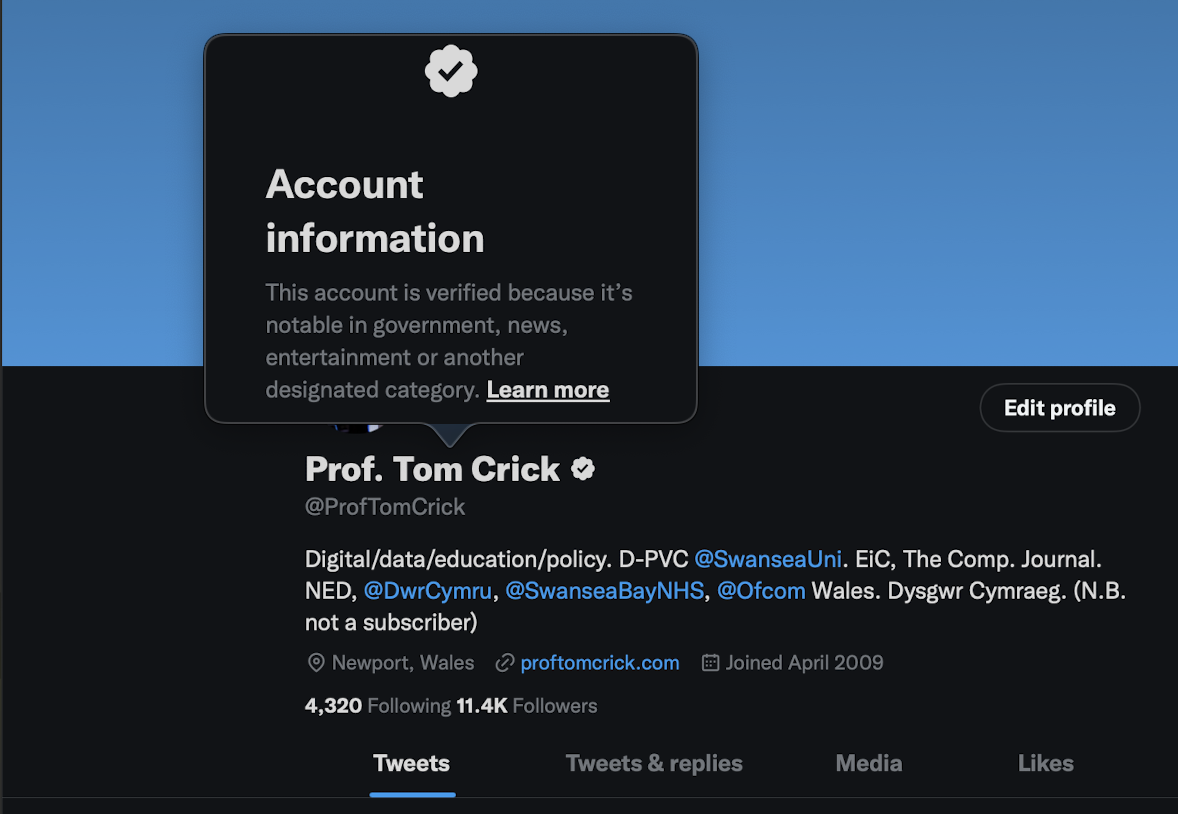
The online environment in which this blog began no longer exists in quite the same form. Personal blogs are less culturally central than they appeared to be in the early 2010s. Twitter is now X, the old verification system has disappeared (I’m not bitter, honest), audiences have dispersed across multiple platforms, newsletters have re-emerged, and AI systems increasingly mediate how writing is produced, found, summarised and encountered.
But that also makes a durable, searchable and personally controlled space more valuable. This remains somewhere I can publish the complete version of an argument rather than an extract shaped around the demands of a platform. It is an archive that is not owned by an employer, tied to a particular appointment or entirely dependent on an algorithmic feed.
I have not systematically gone back to rewrite the earlier posts in the light of what I know or think now. Some now seem naive, overly idealistic or simply embarrassing; there are positions I would no longer fully support, references I would now qualify, and people I treated too uncritically. Feynman, who appeared regularly, is an obvious example: intellectually fascinating and a brilliant communicator, but also a much more controversial and problematic figure than some of my earlier posts acknowledged.
There must be other howlers, as well as plenty that is recognisably of its time. Links have broken, platforms have disappeared, arguments have moved on and I would phrase many things differently today. Where something is factually wrong or genuinely needs additional context, it is right to correct it or add a note. But silently rewriting the archive would replace the record of what I thought then with a tidier account of what I would now prefer to have thought. The untidiness — and occasional embarrassment — is part of its value.
Looking back, it probably took me longer than I realised to find a confident written voice. I have often been bolder when speaking: in a lecture room, on a platform or as part of a discussion, where tone, context and the response of an audience all help to carry an argument. Committing a position to a durable public page felt different.
Some of the earlier posts therefore reported developments, linked to other work or curated material where I might now be more willing to make an argument. I might have been bolder sooner: less inclined to hedge, more willing to take a stronger evidence-based position, and less content merely to describe what was happening. That confidence developed through writing, rather than arriving before it. I am better at this, and more comfortable doing it, than I was; five hundred posts ought to count as practice.
Writing in public carries risks as professional responsibilities accumulate. That is particularly true now in my role as Chief Scientific Adviser at the recently expanded Department for Digital, Culture, Media and Sport (but still DCMS). A personal observation may be read as an institutional position, especially when writing about topics such as AI. That requires care and judgement. But authority should not require the removal of personality or curiosity, nor should an interest in evidence prevent someone from expressing an opinion.
Recent posts have covered statistics, trust and the information ecosystem; the development of evidence infrastructure in government; reflections on seven years of AI research; reclaiming the em dash; and a brief guide to eclipses, aliens and trying to keep quiet. That combination feels closer to what I want the blog to be: a place for serious engagement with technology, systems and public policy, but also somewhere to write about things simply because I find them interesting.
At the average rate so far, post number 1,000 would arrive in the early 2040s, which feels both possible and faintly alarming. The blog may have acquired another name or two by then.
I didn’t have a plan for the first five hundred and don’t have one for the next. For now, writing here is enjoyable again, and the list of things I want to write about is getting longer. That seems like enough of a plan.