The Sun is about four hundred times wider than the Moon. It is also about four hundred times farther away. There is no reason for this. It is a coincidence, and it is the only reason a total solar eclipse looks the way it does — the disc covering the disc almost exactly, close enough to leave the corona showing round the edge.
It is also transient. The Moon is receding from us at roughly 3.8 cm a year, so there was a time when the match was less exact, and there will be a time — hundreds of millions of years from now — when the Moon is too far away for totality to happen at all. We are currently living in the window.
Which is the setup for a classic bit of Iain Banks, doing the rounds again this week for obvious reasons. In Transition, a character works through the Fermi paradox and arrives somewhere unexpected: if there are aliens, and they travel, then most of them will be tourists, and tourists go to see what is rare. Not the Grand Canyon or the Pyramids, necessarily; not even Stonehenge, which at least was aligned with the Sun.
But what I want to propose to you is that, as well as all those other wonders, they would definitely want to see that one precious thing that we have and probably nobody else does. They’d want to see our eclipse.
—Iain Banks, Transition (2009)
So that, he says, is where you look for aliens: along an eclipse totality track. While everyone else is staring upwards, you should be watching the crowd for whoever looks slightly wrong, or overdressed, or is conspicuously declining to come out of their yacht.
I am also working my way through Liu Cixin‘s Remembrance of Earth’s Past trilogy again, which is a gloomier proposition altogether, and takes the same Fermi paradox to a very different conclusion. The dark forest hypothesis is a kind of cosmic game theory: under extreme uncertainty, any civilisation which naively gives away its position risks being destroyed by one that was keeping quieter, so the sensible thing is to say nothing and stay put. Whatever else that implies, it rather rules out the day trip.
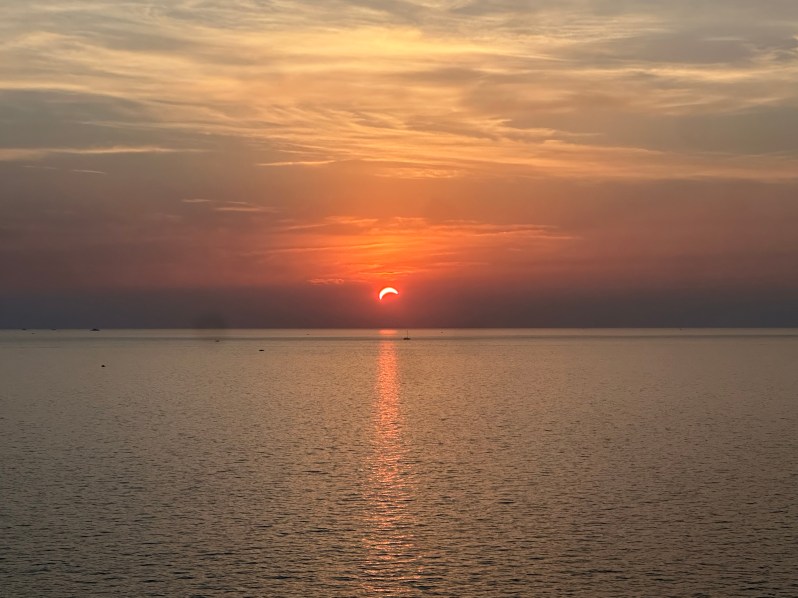
I was in Corsica rather than at home in Wales in August, which put me tantalisingly close to the path of totality. We got about 96%, with the partially eclipsed Sun setting into the Mediterranean as it happened. No corona, no aliens. Wrong track — totality was over the Balearics, the wrong side of six hundred kilometres south-west.
The next total eclipse over the British Isles is not until 23 September 2090, near sunset, for about two minutes. On Liu Cixin’s reasoning, of course, the eclipse is precisely the wrong attraction to have: we did not advertise it, we cannot hide it, and it is the only one in the neighbourhood. The safer strategy is to keep quiet, at least until we have worked out what we would say and how to say it.
Until then: look at the eclipse. And, just in case Banks was right, occasionally look at everyone else.


One thought