The latest episode of the Wales Journal of Education podcast, on generative AI in Welsh education, is my seventh conversation with authors in the series. Its connections with my work on curriculum reform prompted me to look back across those discussions and the journal’s contribution to educational policy and practice.
In May 2020, I wrote about joining Professor Gary Beauchamp and Professor Enlli Thomas as the new editors of the Wales Journal of Education/Cylchgrawn Addysg Cymru. Published by University of Wales Press, the journal had recently adopted a bilingual, platinum open access model, with no charges for readers or authors.
My work on education reform in Wales had included chairing the 2013 independent review of the ICT curriculum, leading the development of the Digital Competence Framework, and chairing the development of the Science and Technology Area of Learning and Experience from 2017 to 2020. Working across research, policy and practice through these reforms had reinforced how much curriculum change depends on schools’ capacity to put new expectations into practice, supported by professional learning and aligned assessment and qualifications. I saw the journal as a way to strengthen the evidence informing reform and enable more practitioners to contribute to it, an ambition we explored in our editorial “Education research in Wales, from Wales, and for Wales”. We argued for closer engagement between university and practitioner research, drawing on international perspectives while supporting research within Wales.
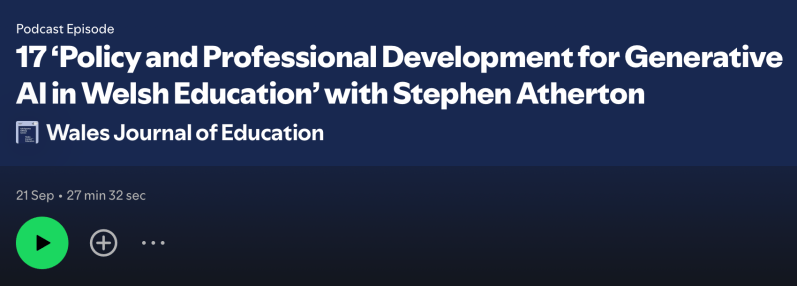
In the latest podcast episode, I speak with Dr Stephen Atherton from Aberystwyth University about generative AI in Welsh education, drawing on his paper with Dr Panna Karlinger and Cyrus Castle, “Policy and Professional Development for Generative AI in Welsh Education”. We discuss how educators are using these technologies, the support they need, and the implications for teaching, assessment and inclusion, in the context of the Curriculum for Wales and the Digital Competence Framework.
When the Digital Competence Framework was published in 2016, its scope already included citizenship, digital rights and data literacy alongside creating and using digital content. These concerns apply directly to generative AI, particularly when learners need to judge the reliability of generated material and understand the consequences of using it. Generative AI also raises questions for teachers about how to develop that judgement and assess learners’ own understanding.
The paper draws on an exploratory survey of educators in Wales, with recruitment targeting primary and secondary schools and further education colleges, to examine their use of AI and the institutional guidance and support available to them. Participants reported gaps in professional development and uncertainty about institutional expectations; the findings offer an account of these experiences rather than a representative picture of provision across Wales.
What counts as appropriate assistance from an AI tool depends partly on what a task is intended to teach or assess, and teachers need time to explore those distinctions through professional learning. Decisions about which tools to use also need to consider their suitability for Welsh language provision and different accessibility needs, alongside whether learners have equitable access to them.
One theme in my conversation with Stephen was the pace at which generative AI tools are developing, and how their emerging effects on education vary across settings. This makes it difficult to keep national policy current and useful as capabilities and uses change, while providing a workable basis for institutions and practitioners to decide what is responsible and appropriate in their own contexts. Guidance needs to be usable in everyday practice, with scope to revisit decisions as experience and evidence accumulate.
In our May 2026 editorial, we examined the capacity needed to sustain educational reform, including professional expertise, institutional support and funding. In schools and colleges, these considerations also apply to AI adoption: responding to new technologies draws on the same staff time and resources needed to implement changes to curriculum and qualifications.
Supporting educational policy and practice through research is central to the journal’s work, which extends beyond AI and curriculum reform. The Wales Journal of Education publishes research on education throughout the life course, with Welsh Government support enabling its bilingual, open access publication. As editors, we seek to publish methodologically rigorous research that can inform the decisions made by policymakers and practitioners. Our focus on Wales includes comparative and international research, both to shape developments here and to contribute Welsh research and experience to debates elsewhere. Through review and revision, we work with authors to make clear what their research contributes, the strengths and limitations of its evidence, and how its findings might inform decisions or practice in other settings. Making that work accessible requires attention to how it is communicated and who can use it. Alongside removing charges for readers and authors, we consider language, format and the time available to engage with research, while retaining the detail needed to assess its quality and relevance.
Our Focus on Practice/Ffocws ar Ymarfer collection publishes shorter articles investigating educational practice, subject to academic review. Contributions can be submitted in Welsh or English and are published bilingually, with a peer-mentored approach that supports authors, including those new to academic publishing. By supporting practitioners to publish research arising from their own settings, the collection broadens the experience represented in the journal and allows others to examine and build on that work.
In the podcast, Gary, Enlli and I discuss the findings with authors and ask how their experiences shaped the research. These conversations give us more space to explore the reasoning behind a paper and what it might mean for those working in education.
My six earlier conversations in the series cover:
- Episode 2: learning from lectures. With Dr Robin Owen, on self-control, motivation and mental effort in undergraduate learning.
- Episode 5: mentoring new teachers. With Dr Luke Jones and Gethin Foulkes, on mentoring in the CaBan initial teacher education programme.
- Episode 6: parent governors. With Dr Allan Glyndwr Meredith, on parent governors’ experiences in a deprived south Wales community.
- Episode 8: parental engagement. With Professor Janet Goodall, on relationships and partnerships in initial teacher education.
- Episode 13: international languages. With Dr Elin Arfon and Glesni Owen, on learners’ perspectives in Welsh secondary schools.
- Episode 16: vulnerable learners. With Dr Alex McInch, on post-pandemic provision and engagement in a Welsh local authority.
Conversations from across these podcast episodes have often brought me back to questions I encountered during curriculum reform. The Curriculum for Wales gives schools substantial responsibility for developing a curriculum within a national framework, informed by their learners and local communities. That makes subsidiarity a practical question about professional discretion, the capacity to exercise it and the support available when difficult choices arise. How do schools draw on local knowledge and research evidence when developing their curriculum? How can provision respond to differences in language, place and learners’ experiences while maintaining high expectations and equitable opportunities across Wales? Evidence from practice needs to be able to influence the direction of reform as well as inform its implementation. A journal can contribute by providing a place where those experiences are examined critically and made available to others facing similar decisions.
My thanks to everyone who has joined these conversations to date, and to my editorial colleagues and the team at University of Wales Press. You can listen to Episode 17 and the full series here, or find the podcast on Apple Podcasts and Spotify. We very much welcome submissions to both the main journal and Focus on Practice, from Wales and internationally, in Welsh or English; if you would like to discuss whether your work would be suitable, please get in touch.

