On 18 November 2026, Voyager 1 became the first human-made object to reach a distance of one light-day from Earth. At 10:16:07 UTC, the spacecraft was approximately 25.9 billion kilometres away, having travelled outwards through the solar system since its launch on 5 September 1977. NASA confirmed the milestone the following day, more than 49 years after a mission originally intended to explore Jupiter and Saturn had begun.
A light-day is the distance light travels in 24 hours, at approximately 300,000 kilometres per second. Voyager is moving away from the Sun at around 61,000 kilometres per hour, and a radio signal now needs a full day to travel between the spacecraft and Earth. The milestone marks a distance, not a physical boundary: Voyager encountered no particular change in its surroundings at that instant. The achievement nonetheless gives us a way to think about the distance covered by a mission that began almost half a century ago, and the rather greater distances that still separate us from the stars.
My fascination with astronomy and cosmology goes back to childhood, with astronomy posters on my bedroom walls and hours spent drawing the Solar System and reading books about space. I was fascinated by the different characteristics of the planets, the physical processes that made them so different from one another, and how nuclear fusion powered the Sun. I knew relatively little of the underlying mathematics or physics, but wanted to understand how the Solar System worked, the distances involved and how it all fitted into the wider universe.

Science fiction was part of that interest from early on; Star Trek gave it an imaginative setting in which exploration, scientific expertise and human judgement mattered, themes I returned to in my recent reflections on Patrick Stewart and Jean-Luc Picard. Douglas Adams, meanwhile, reminded us in The Hitchhiker’s Guide to the Galaxy that “Space is big. Really big.” His treatment of that scale, and of the absurdities of trying to comprehend it, is behind the title of this post. I originally planned to study physics at university before eventually finding my way to computer science; Voyager brings those interests together, from the scientific questions that motivated the mission to the computing and engineering that have sustained it for nearly fifty years.
The scale of interstellar distance
In astronomy, expressing distance as the time required for light to travel between objects often conveys more than a very large number of kilometres. Light reflected from the Moon takes about 1.3 seconds to reach Earth, while sunlight arrives after eight minutes and twenty seconds. Neptune is roughly four light-hours away, depending on where the planets are in their orbits, while Voyager 1 is now a full light-day from home. NASA’s interactive Eyes on the Solar System is a useful way to explore the trajectory and get some sense of the relative distances.
Voyager 1 crossed the heliopause in August 2012, entering the interstellar medium beyond the region where the outward flow of solar wind dominates the surrounding plasma. Its instruments could then directly measure magnetic fields and charged particles beyond the heliosphere. The much more distant Oort Cloud, an inferred reservoir of icy bodies thought to be the source of long-period comets, extends far beyond Voyager’s present position. NASA estimates that the spacecraft will take another 300 years or so to reach its inner edge.
The distances to even the nearest stars are greater still. Our nearest stellar neighbour beyond the Sun, Proxima Centauri, is approximately 4.24 light-years away, equivalent to more than 1,500 light-days. If a spacecraft could travel directly towards it at Voyager’s present speed, the journey would take roughly 75,000 years. Voyager 1 is following a different trajectory and, in about 40,000 years, is expected to pass within 1.7 light-years of Gliese 445. That counts as a relatively close encounter on a galactic scale, even though 1.7 light-years represents roughly 16 trillion kilometres. Its twin, Voyager 2, is travelling in a different direction and at a somewhat slower speed, and NASA expects it to reach a distance of one light-day from Earth in November 2035; by then, its available electrical power may no longer be sufficient to maintain communications. Both spacecraft will continue their journeys long after their scientific instruments have fallen silent.
Designing the Voyager mission
Voyager’s trajectory grew out of an opportunity identified in the 1960s, when engineers at NASA’s Jet Propulsion Laboratory recognised that the outer planets would reach a favourable arrangement in the late 1970s. Such configurations occur approximately once every 175 years and make it possible to link planetary encounters through a sequence of gravitational assists. Instead of supplying every change in velocity through onboard propellant, the spacecraft could exploit the gravitational field and orbital motion of a planet to alter its speed and direction relative to the Sun. The technique depends on extremely accurate navigation: each encounter changes the conditions for the next, so the route has to be calculated and corrected as a connected sequence.
An ambitious Grand Tour of the outer planets was initially considered, but costs led NASA to approve a more limited mission focused on Jupiter and Saturn, with spacecraft designed for a nominal five-year lifetime. Voyager 2 launched first, on 20 August 1977, and subsequently reached Uranus and Neptune; Voyager 1 followed sixteen days later and took a different path after visiting Jupiter, Saturn and Titan. The two trajectories created complementary scientific opportunities, and the encounters ultimately extended well beyond the programme’s initial ambitions.
James Burke’s report from NASA as Voyager 2 lifted off remains one of my favourite examples of science broadcasting, with the rocket appearing behind him almost exactly when he describes it. Burke’s wider work, especially Connections, was concerned with how science and technology develop through relationships between ideas, people, institutions and events. Watching that 1977 footage now, I am struck by how much of Voyager’s story was still to come, including the work of generations of scientists and engineers confronting problems its designers could never have anticipated in detail.
The spacecraft had to survive years without physical maintenance, traverse intense radiation environments around the gas giants, keep their 3.7-metre high-gain antennas accurately pointed towards Earth and operate scientific instruments with increasingly limited power and data rates. Solar panels were impractical for a mission travelling so far from the Sun, where the available sunlight falls rapidly with distance, so each spacecraft carried three radioisotope thermoelectric generators, which produce electricity from heat released by the decay of plutonium-238. The design also incorporated redundant components, autonomous fault protection and software that could be modified after launch, choices that would become increasingly important once the original planetary encounters were over.
The scientific results justified the effort. Voyager 1 revealed active volcanism on Jupiter’s moon Io, uncovered intricate structures in Saturn’s rings and established that Titan has a dense, nitrogen-rich atmosphere; Voyager 2 became the only spacecraft to visit Uranus and Neptune. Those discoveries transformed our understanding of the outer solar system, while the mission’s continuation into interstellar space required engineers to operate and adapt the original systems at distances and over timescales far beyond their intended design life.
Computing and software engineering across five decades
Voyager was launched in 1977, the year the first Star Wars film reached cinemas and the Apple II went on sale. Personal computing was still emerging, and the World Wide Web lay more than a decade in the future. Voyager’s onboard systems were developed for a tightly constrained set of functions, with computational resources vastly more limited than those available in today’s everyday devices.
Each spacecraft has three computer systems, originally duplicated for redundancy: the Computer Command System, responsible for command execution, sequencing and fault responses; the Flight Data System, which processes scientific and engineering information; and the Attitude and Articulation Control System, which keeps the spacecraft correctly oriented. Together, the computers have less than 70 kilobytes of memory. This distributed architecture assigned distinct functions to specialised systems, with redundancy intended to help maintain operations when components failed. The architecture also reflected different performance requirements: the Flight Data System used faster CMOS circuitry and memory to handle the high data rates of planetary encounters, while the command and attitude-control computers relied on TTL logic and plated-wire memory. Redundancy has diminished over time: Voyager 1 lost its backup Flight Data System in the early 1980s, so there was no functioning spare computer to take over during the 2023–24 telemetry failure.
Remote reprogramming was therefore an essential capability — commands and software changes could be sent from Earth as mission requirements evolved or faults developed, but the practical demands of doing so became greater as the spacecraft moved farther away and its components aged. In November 2023, Voyager 1 began transmitting unusable data back to Earth, despite continuing to receive and execute commands. After months of investigation, engineers identified a damaged memory chip in the Flight Data System containing part of the code used to prepare telemetry for transmission. Replacing the chip was impossible, and there was no single sufficiently large block of working memory into which the affected software could be moved. Engineers therefore split the code into smaller sections, placed them in available areas of memory, and adjusted instructions and references to account for the new locations. All of this work was manual; as JPL’s Jeff Mellstrom explained to EEJournal, the original development tools, hardware testbeds and software emulators were no longer available. The engineers had no representative environment in which to execute the modified code before transmission and verified their changes by inspecting the instructions. On 20 April 2024, NASA received usable engineering data again; further work restored the science data.
The most interesting aspect of this repair is how much of the work normally supported by assemblers, linkers and other development tools had to be performed by hand. Relocating executable instructions across scattered free memory requires care with addresses, jumps and references to code that has moved, especially on a processor whose original toolchain has disappeared. The engineers were effectively doing the painstaking parts of code relocation and linking themselves, inspecting the result rather than running a test build on an equivalent machine. Each change then had to be transmitted to a spacecraft more than 22 light-hours away, with nearly two days elapsing before a response could confirm whether it had worked.
Such repairs also depend on people who understand the history of a system. In a November 2026 interview with Sky & Telescope, Voyager project scientist Linda Spilker, who joined the programme in 1977, described a team of around ten people, including a 25-year-old communications engineer and a Flight Data System specialist who had recently turned 90. Several generations of engineers have preserved and transferred expertise about hardware and software whose original development environments have largely vanished. This is a direct connection with Margaret Hamilton’s contribution to software engineering: dependable software requires attention to fault handling, verification, and how software behaves within the wider system throughout its operational life.
Power, reliability and fault recovery
The demands of maintaining Voyager’s ageing systems extend well beyond its computers: in 2025, NASA engineers reactivated a set of primary roll-control thrusters that had been considered unusable since 2004, after revisiting a fault involving their heaters and associated power circuits. The backup thrusters had been developing obstructions caused by residue in their fuel tubes, creating a growing risk to the spacecraft’s ability to keep its antenna pointed at Earth. The recovery required an understanding of faults recorded more than twenty years earlier and of components that had not been exercised for much of that time.
Electrical power is now the more persistent constraint; the output from Voyager’s radioisotope generators declines by roughly four watts each year, forcing decisions about which instruments, heaters and other devices can remain powered. In April 2026, the team switched off the Low-Energy Charged Particles experiment, leaving the magnetometer and plasma wave subsystem as Voyager 1’s two remaining powered science instruments. Both have contributed to a scientific programme that would have been impossible to plan in detail when the spacecraft was built, measuring the magnetic fields and plasma of the interstellar medium beyond the heliopause. Each instrument switched off reduces the range of measurements available from a region that only the two Voyagers have reached, making the decision about how to allocate the remaining power a scientific as well as an engineering judgement.
In 2020, Voyager 1 recorded a strong event in which magnetic-field strength and electron plasma density increased and remained elevated. Linda Spilker described these observations as unexpected, with activity originating at the Sun a possible explanation. The persistence of the change challenges earlier expectations about conditions in the interstellar medium and the reach of solar disturbances, while illustrating the value of observations sustained over many years rather than confined to a relatively brief encounter. NASA deputy project scientist Jamie Rankin discusses the continuing scientific questions in a recent Curious Universe episode, including how Voyager’s measurements have informed our understanding of the region beyond the heliopause.
In September 2026, engineers completed a carefully coordinated power-saving operation nicknamed the “Big Bang”, switching three powered devices to lower-power alternatives. The devices also contributed heat, so the team had to account for the thermal consequences of reducing their electrical demand. The successful intervention may defer the need for another instrument shutdown that would otherwise have become necessary as early as summer 2027. On an ageing spacecraft with narrow operating margins, a power saving cannot be assessed without considering its effects on temperature, fuel lines, instrument calibration and the reliability of other components.
This is a practical instance of the systems-engineering problem I explored in Finding the cut: the behaviour of a complex system depends on relationships and constraints that are not apparent from the condition of any one component. A change that improves the power budget may make thermal management harder; an attitude-control fault may become a loss of communications; a damaged memory chip may prevent an otherwise functioning spacecraft from returning intelligible data. Voyager’s longevity has relied on preserving the institutional capacity to recognise and work through those dependencies, including the documentation, engineering analysis and specialist expertise needed to assess and implement changes long after the original designers expected the mission to end.
Communication and control at one light-day
Every command sent to Voyager now takes about 24 hours to arrive, and another day must pass before its response reaches Earth. A sequence of diagnostic commands can therefore occupy days or weeks, even when each individual action is simple. The spacecraft’s transmitter also works with very little power by contemporary standards. NASA’s Deep Space Network, using large antennas in California, Spain and Australia, receives its faint signals; the normal scientific downlink rate is around 160 bits per second. Advances in receivers and signal processing have helped sustain this connection, but no improvement in radio technology can shorten the time required for a signal to cross that distance.
The importance of onboard fault protection was demonstrated in October 2026, when Voyager 1 temporarily disappeared from radio contact during two scheduled communications opportunities, before its signal was recovered on 20 October. NASA subsequently established that one group of attitude-control thrusters had gone offline and backup thrusters had been activated by the onboard fault-protection software. The spacecraft was able to respond to the problem without waiting for a command from Earth, precisely the capability needed when the effects of an unexpected fault could develop long before ground controllers were able to intervene.
A further communications problem arose on 14 November, when the Deep Space Network received Voyager 1’s radio carrier signal but no usable science or engineering data. The carrier indicated that the spacecraft was still transmitting towards Earth, while the absence of intelligible telemetry deprived engineers of the information normally used to assess its condition. NASA reported the problem on 18 November; when the one-light-day milestone was confirmed the following day, engineers were investigating the cause and whether it might be associated with the October interruption. The spacecraft’s distance could still be established from the carrier signal and its calculated trajectory.
In my earlier discussion of WarGames, I considered the assumptions made when important decisions are delegated to computers. Voyager provides a specific engineering case: fault-protection software must recognise certain failures, activate appropriate backup systems and preserve a condition in which ground controllers can diagnose the problem once a signal is received. With a day’s delay in each direction, engineers exercise control through the system’s design and operating procedures as well as through the commands they send.
The Golden Record
Voyager also carries the Golden Record, a gold-plated copper phonograph disc containing images, music, greetings and natural sounds selected to communicate something about life on Earth to any extraterrestrial civilisation that might find it. Carl Sagan chaired the committee responsible for the contents, which include 115 images, greetings in 55 languages, music from different cultures and traditions, recordings of the natural world and messages from President Jimmy Carter and UN Secretary-General Kurt Waldheim. Instructions on the protective cover attempt to explain how the information could be recovered, using diagrams based on physical and mathematical relationships that a recipient might recognise without knowing any human language.
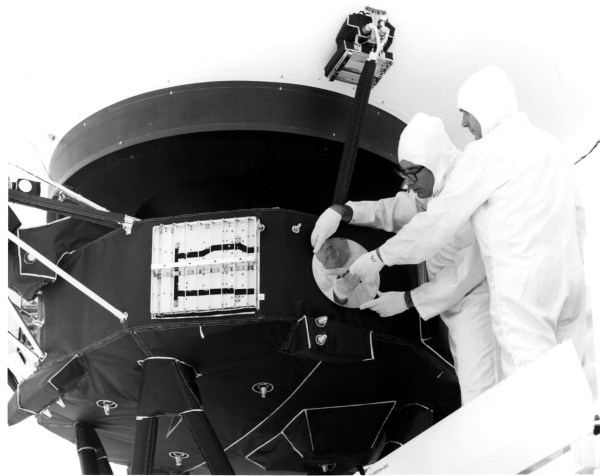
The Golden Record was assembled by a relatively small group working amid the political and cultural divisions of the Cold War, who had to decide what might represent humanity to an unknown audience and how much of human experience could be expressed through a limited selection of images and sounds. I wonder what we would choose today, who would be invited to take part and whether a contemporary attempt would find it any easier to agree on what should be included.
Back in July 2011, I quoted Douglas Adams’s splendid argument in The Restaurant at the End of the Universe that there are infinitely many worlds, but not all of them are inhabited, so the number of inhabited worlds must be finite. By a characteristically unorthodox application of mathematics, he then concludes that the average population of the universe is zero, and that anyone we happen to meet must be a product of a deranged imagination; if Adams is right, the Golden Record has a fairly limited audience.
Other science-fiction writers have been less sanguine about contact with extraterrestrial intelligence. In my earlier discussion of eclipses, aliens and the possibility of keeping quiet, I considered Liu Cixin’s dark forest hypothesis, in which uncertainty about the intentions and technological capabilities of other civilisations makes the disclosure of one’s own location potentially dangerous. Voyager embodies a rather different assumption about the value of announcing our existence, though sending a physical record attached to a small spacecraft is vastly less detectable than deliberately transmitting powerful radio signals across interstellar space. The chances of anyone encountering the record and working out how to play it are remote. Depending on whose account of cosmic sociology you find more persuasive, that may be just as well.
The challenge of interstellar travel
Science fiction has made travel between stellar systems familiar to generations of readers and viewers, including me. In practice, reaching another star would require velocities and energies far beyond those involved in the planetary missions we have undertaken. The Golden Record is therefore likely to travel for a very long time without approaching any inhabited world, assuming there is one to encounter.
NASA’s Artemis II mission took four astronauts around the Moon in April 2026, while further lunar missions and possible journeys to Mars present substantial challenges in propulsion, life support and radiation protection. Those destinations are measured in light-seconds or light-minutes from Earth, rather than light-years. Spacecraft speed offers a useful comparison; NASA’s Parker Solar Probe has reached about 692,000 kilometres per hour relative to the Sun during close solar encounters, making it the fastest human-made object by that measure. Even if a spacecraft could sustain that speed on a suitable trajectory to Proxima Centauri, the journey would still take more than 6,000 years.
Conventional chemical propulsion cannot deliver a substantial spacecraft to an appreciable fraction of the speed of light without prohibitive propellant requirements. Nuclear fission and fusion have long been investigated as possible alternatives, while proposals for laser-driven light sails envisage accelerating very small probes to considerably higher speeds. A useful interstellar mission would have to solve other problems as well: surviving impacts with dust and gas at high velocity, maintaining instruments and communication systems during a long journey and, for a mission intended to do more than fly past its destination, finding some means of decelerating on arrival.
Warp propulsion belongs to a more speculative part of the discussion. In 1994, Miguel Alcubierre published a solution to Einstein’s field equations describing a geometry in which spacetime would contract ahead of a spacecraft and expand behind it, potentially permitting effective faster-than-light travel without locally exceeding the speed of light. There is a pleasing Welsh connection: Alcubierre was working at the University of Wales, College of Cardiff (now Cardiff University) when the paper appeared. His model requires exotic negative-energy matter, and there is no established route to physical implementation.
A crewed interstellar mission would also need radiation protection, closed-loop life support and arrangements for medical care and human wellbeing over decades or generations. At velocities approaching that of light, relativistic time dilation would mean different elapsed times for travellers and for those who remained on Earth, but reaching and sustaining such velocities remains far beyond present propulsion capabilities.
The observable universe and its limits
Telescopes already allow us to investigate regions that no spacecraft could reach within anything resembling a human timescale. In 2004, astronomers published the Hubble Ultra Deep Field, assembled from repeated observations of a minute patch of sky. Within a region that appears almost empty, Hubble revealed nearly 10,000 galaxies, many seen as they were billions of years ago.
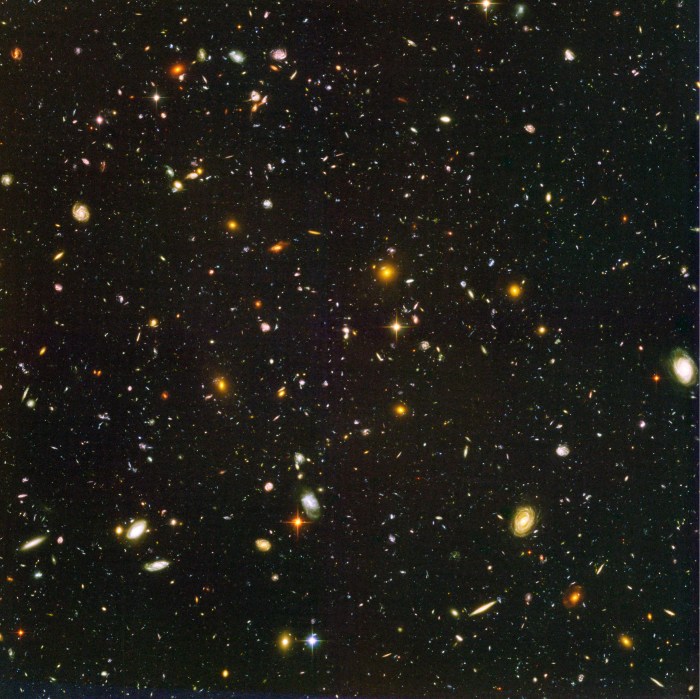
Observations with the James Webb Space Telescope have since taken astronomers closer to the earliest stages of galaxy formation. In January 2026, astronomers reported observations of MoM-z14, a galaxy seen as it existed roughly 280 million years after the Big Bang. Its light had been travelling for more than 13 billion years before reaching the telescope. Voyager, meanwhile, measures the environment immediately around it at a distance of one light-day. The scientific methods are fundamentally different: astronomical observations reconstruct the properties of distant objects from the radiation arriving here, while a spacecraft can make direct measurements of the conditions through which it travels.
The universe is estimated to be 13.8 billion years old, but the diameter of the observable universe is around 92 billion light-years. That apparent discrepancy arises because space itself has expanded while the radiation we now receive was travelling towards us, so the present distance to the most remote observable regions is much greater than 13.8 billion light-years. The observable universe is defined by what has had time to send us information since the early stages of cosmic history; it should not be confused with the universe as a whole, whose extent and global geometry remain uncertain. In the standard cosmological model, accelerating expansion also gives rise to an event horizon beyond which light emitted today will never reach us. We can receive ancient radiation from some distant galaxies even though signals they emit now are destined never to arrive. Better instruments will extract more information from the radiation that reaches us, but cannot make every distant part of the universe causally accessible.
The Pale Blue Dot
On 14 February 1990, after its planetary encounters had ended, Voyager 1 turned its cameras towards the inner solar system and photographed Earth from around six billion kilometres away. The resulting Pale Blue Dot photograph shows our planet occupying less than a pixel within a band of scattered sunlight. Carl Sagan’s reflections on it have become part of the cultural history of space exploration, encouraging us to consider how all of human history, with its achievements and conflicts, has unfolded on a world almost invisible in the image.
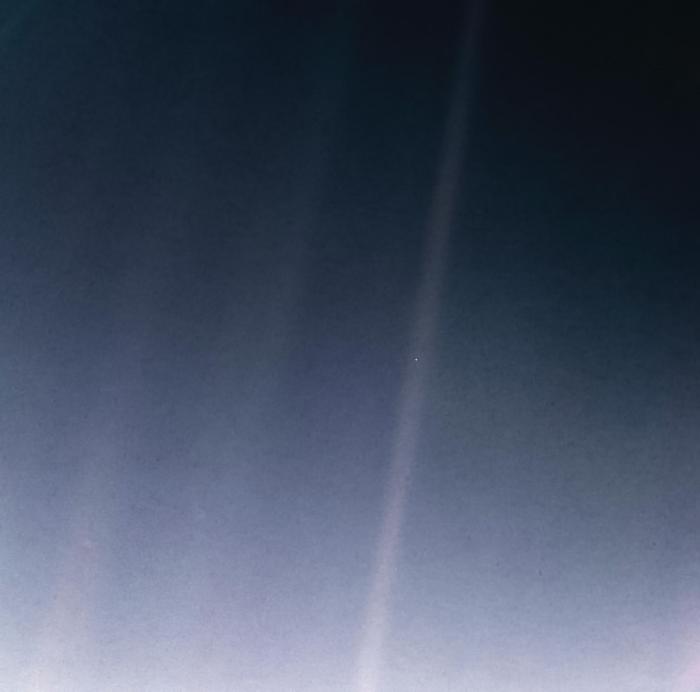
The cameras were switched off after the solar system portrait as the spacecraft’s scientific priorities changed, and the software needed to operate them was subsequently removed. The original ground-based image-processing systems are no longer available, and the hardware has spent decades in the cold of deep space. The decision reflected the practical demands of the extended mission: as power and resources became more limited, instruments useful for studying the outer heliosphere and interstellar medium took precedence over further imaging.
The relationship between the Golden Record and the Pale Blue Dot has always interested me: one attempts to describe Earth to an unknown recipient, while the other shows how little of our planet can be seen from a distance that is still modest by interstellar standards. Both emerged from a mission originally designed to study Jupiter and Saturn, and both have acquired a cultural significance alongside a much larger scientific record, from discoveries at the outer planets to direct measurements of the interstellar environment.
Voyager will eventually cease communicating as its electrical power declines or when a fault arises that its engineers cannot resolve. The spacecraft will continue through interstellar space with the Golden Record aboard, while its observations will remain available to scientists long after the last signal reaches Earth. The work of keeping it operational for decades beyond the original mission has allowed those observations to accumulate, despite the progressive loss of hardware, power and redundancy.
Nearly fifty years after launch, Voyager 1 is one light-day from Earth. That is an extraordinary achievement for a spacecraft, and a very small distance by the standards of the universe.

